
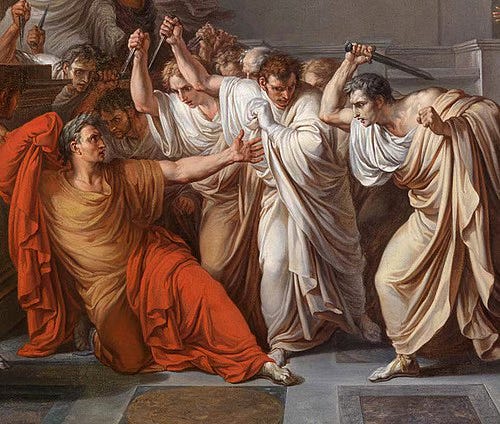
When Julius Caesar convened a Senate session, it turned out to be his last. He had just walked into a closed room full of conspirators intent on assassinating him once their leader gave the signal. The signal was given and the Roman Senators descended on Julius Caesar and stabbed him 23 times. But before he dies, he recognizes his close friend Marcus Brutus amongst the 60 conspirators and cries, “Et tu, Brute?”
This true historical event was dramatized later in William Shakespeare’s play The Tragedy of Julius Caesar which made “Et tu, Brute?” synonymous with betrayal from a close friend. It means “Even you, Brutus?” Depicted in the 1806 painting, titled The Death of Julius Caesar, Brutus can be seen looking away from Caesar, unable to meet his gaze. Rather than defending himself, Caesar is gesturing forward and exhausting his last words to prove to Brutus that he is aware of his betrayal. Brutus, ashamed, cannot bear to lock eyes as he too stabs Caesar. Some accounts question whether Caesar spoke at all, but nonetheless, “Et tu, Brute?” is a dramatic example of unexpected betrayal that can surprisingly teach Christians a lesson.
Amongst all Christian virtues, forgiveness remains the most elusive. It is possible to express forgiveness towards my enemy, talk about how much I have forgiven my enemy, and yet in my heart remain stubbornly unforgiving. Arguably, it is the most dangerous spiritual condition to be in. It led to humanity’s first murder when Cain could not forgive Abel for offering a more worthy gift to God.[1] Jesus, knowing the danger of this long-embedded sin in humanity teaches us that forgiveness is a necessity of the Christian walk.
In the Sermon on the Mount, Jesus instructs us to pray verbatim, “And forgive us our trespasses, as we forgive those who trespass against us (emphasis added).”[2] “As” means there is a precondition to receiving our forgiveness from God. It is clearly a reciprocated gift. Failure to forgive others results in rejecting the gift of forgiveness from God.
Later in the Gospel of Matthew, Jesus teaches again about the necessity of reciprocated forgiveness by sharing a parable about the kingdom of heaven. A king was moved with compassion at the inability of his servant to pay back a debt. The servant had begged the king on his knees for patience and more time. Instead of more time, the king forgives the whole debt owed. But not just any debt owed – the servant owed 10,000 talents, an impossibly large sum to pay back, larger than lifetimes of earnings. Nonetheless, the king forgives the servant his debt and releases him to go free.
But later, the king learns that the very same servant whom he forgave, did not likewise forgive his own servant a debt and instead grabs him by the throat and demands repayment. Adopting a familiar position, the servant’s servant begs for more time at his feet, but to no avail. He is thrown into prison. And what was the debt the servant’s servant owed? It was 100 denarii or about three months of labor. When the king learns about his servant’s lack of reciprocated forgiveness, he angrily summons him.
“Then his master, after he had called him, said to him, ‘You wicked servant! I forgave you all that debt because you begged me. Should you not also have had compassion on your fellow servant, just as I had pity on you? And his master was angry, and delivered him to the torturers until he should pay all that was due to him.”[3]
Paying the king back of course, was impossible. Seemingly he is to remain with the torturers forever, mirroring the endless torture of Hades. Jesus ends the parable with a direct warning that leaves no ambiguity.
“So My heavenly Father also will do to you if each of you, from his heart, does not forgive his brother his trespasses (emphasis added).”[4]
If we fail to forgive our brothers – from our hearts – will be like Brutus stabbing Julius. To be clear, Julius Caesar bears no semblance to Jesus Christ.[5] But his parting words can foreshadow an experience none of us who confess Christianity will want to have on Judgement Day. If we fail to forgive our brothers, we reject God’s own gift of forgiveness for ourselves. We betray Jesus. Jesus Christ will look at us with the same eyes that Julius had for Brutus. How could you betray me, Christopher? You were supposed to be my friend; you were supposed to be on my side. I told you that you must forgive your brother’s debt because I forgave your own, much larger debt. Christopher, I trusted you to remember and to practice this. Thus, help me God, to learn to truly forgive so when Judgment Day comes, I never hear, “Et tu, Christopher?”
[1] Genesis 4:8
[2] Matthew 6:12
[3] Matthew 18:32-34
[4] Matthew 18:35
[5] Interestingly, Julius Caesar is succeeded by Caesar Augustus who was the Roman emperor during the birth of Jesus Christ (see Luke 2:1)
Strong connection btween the parable and the Brutus story. The reciprocity angle is what makes forgiveness so challenging bc it means our relationship with God hinges on somthing we actively do not just believe. I've struggled with forgiving minor stuff while glossing over the debt God already forgave me.